Paediatric Weight-Based Calculations
Calculating paediatric weight-based medications is used because medication doses for children must be adjusted according to body size. Standard adult doses are not appropriate, so weight-based dosing ensures the child receives a safe and effective amount. Accuracy is critical, as even small errors can result in significant underdosing or overdosing.
What You Need to Know
Paediatric doses are commonly prescribed in mg/kg, mcg/kg, or units/kg. The child’s weight must be in kilograms, and this is used to calculate the required dose before determining how much medication to administer.
Key points:
weight must always be in kilograms
the prescribed dose is given per kg of body weight
calculations often involve two steps: calculate the dose, then calculate how much to give
the final answer must match the medication form (mg, mL, tablets, or mL/hr)
A quick check:
higher weight = higher dose
if weight is given in pounds, divide by 2.2 to convert to kg
always sense-check the final answer before administering (for example, if you think the final dose is not reasonable or outside of recommended guidelines, recalculate, double-check with an appropriately experienced clinician, or verify with the prescriber whether the dose is appropriate or not)
The Formula
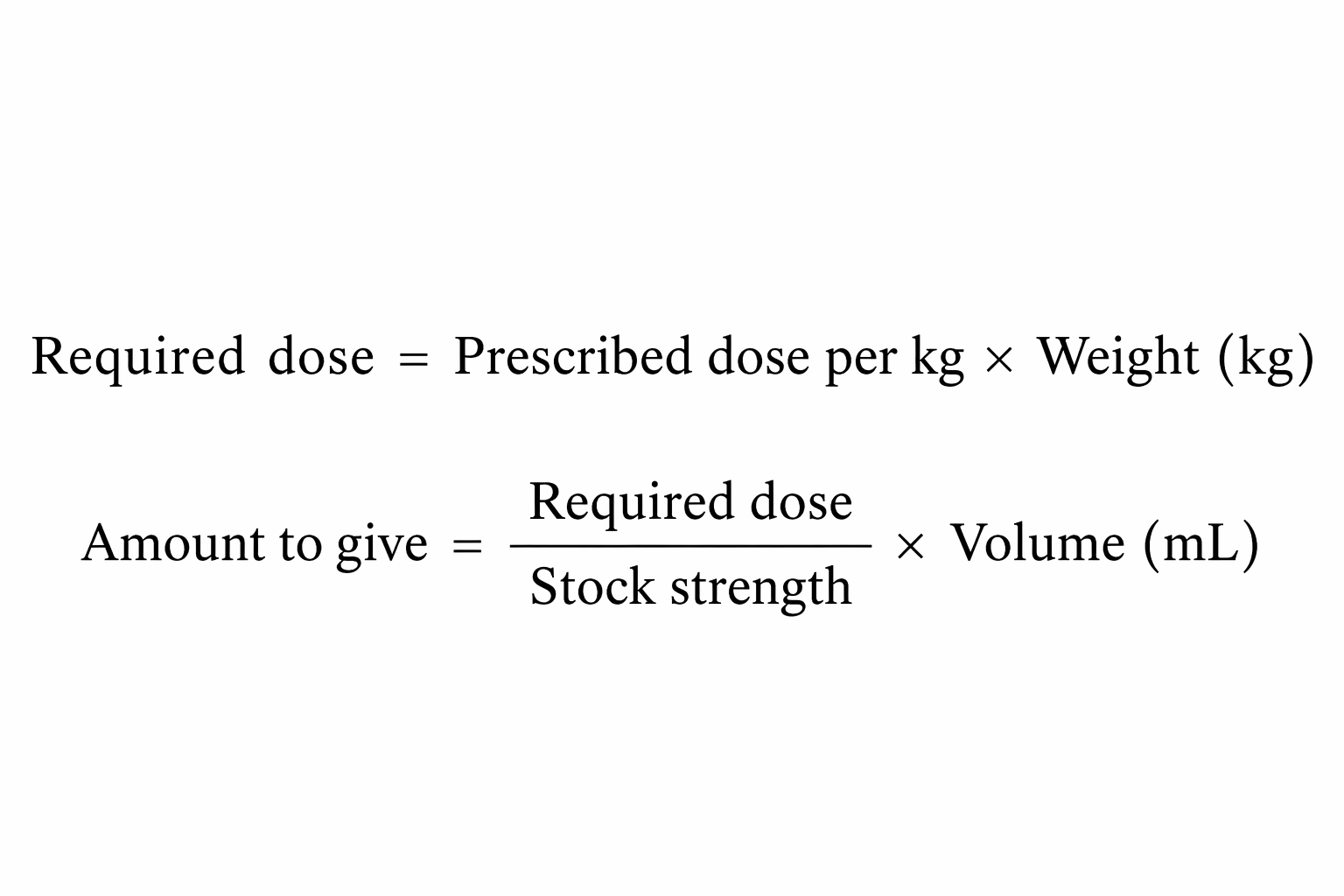
Required dose = Prescribed dose per kg × Weight (kg)
Amount to give = (Required dose ÷ Stock strength) × Volume
Where:
Required dose = dose calculated using the child’s weight
Stock strength = amount of drug available
Volume = mL the stock is contained in (for liquids or IV medications)
Worked Examples
Example 1
Order: 15 mg/kg
Weight: 20 kg
Required dose = 15 × 20 = 300 mg
Answer: 300 mg
Example 2
Order: 10 mg/kg
Weight: 18 kg
Stock: 250 mg in 5 mL
Required dose = 10 × 18 = 180 mg
Amount to give = (180 ÷ 250) × 5
Amount to give = 0.72 × 5 = 3.6 mL
Answer: 3.6 mL
Example 3
Order: 5 mcg/kg
Weight: 12 kg
Required dose = 5 × 12 = 60 mcg
Answer: 60 mcg
Practice Questions
Order: 20 mg/kg, weight: 15 kg
Order: 8 mg/kg, weight: 25 kg, stock: 200 mg in 5 mL
Order: 12 mcg/kg, weight: 10 kg
Order: 15 mg/kg, weight: 30 kg, stock: 250 mg in 5 mL
Order: 6 mg/kg, weight: 22 kg, stock: 120 mg in 4 mL
(Scroll down for answers)
Answers
20 × 15 = 300 mg → 300 mg
8 × 25 = 200 mg, (200 ÷ 200) × 5 = 5 mL → 5 mL
12 × 10 = 120 mcg → 120 mcg
15 × 30 = 450 mg, (450 ÷ 250) × 5 = 9 mL → 9 mL
6 × 22 = 132 mg, (132 ÷ 120) × 4 = 4.4 mL → 4.4 mL