Unit Conversion in Clinical Calculations
Accurate unit conversion is a fundamental component of clinical calculations in nursing. Medications may be prescribed, supplied, and documented in different units, and converting between grams, milligrams, and micrograms is required to ensure the correct dose is administered. These conversions follow a simple pattern, but mistakes can lead to significant dosing errors.
What You Need to Know
Gram-based units follow a base-10 (decimal) system, meaning each step up or down involves multiplying or dividing by 1000.
Key conversions:
1 gram (g) = 1000 milligrams (mg)
1 milligram (mg) = 1000 micrograms (mcg)
1 gram (g) = 1,000,000 micrograms (mcg)
Converting between units always follows the same rule:
moving to a smaller unit (g → mg → mcg) = number becomes larger
moving to a larger unit (mcg → mg → g) = number becomes smaller
A simple way to visualise this:
g → mg → mcg
The Formula
Conversions are based on multiplying or dividing by 1000.
mg to g × 1000
mcg to mg × 1000
g to mg ÷ 1000
mg to mcg ÷ 1000
A useful shortcut is to move the decimal point:
multiply by 1000 → move decimal 3 places right
divide by 1000 → move decimal 3 places left
For example:
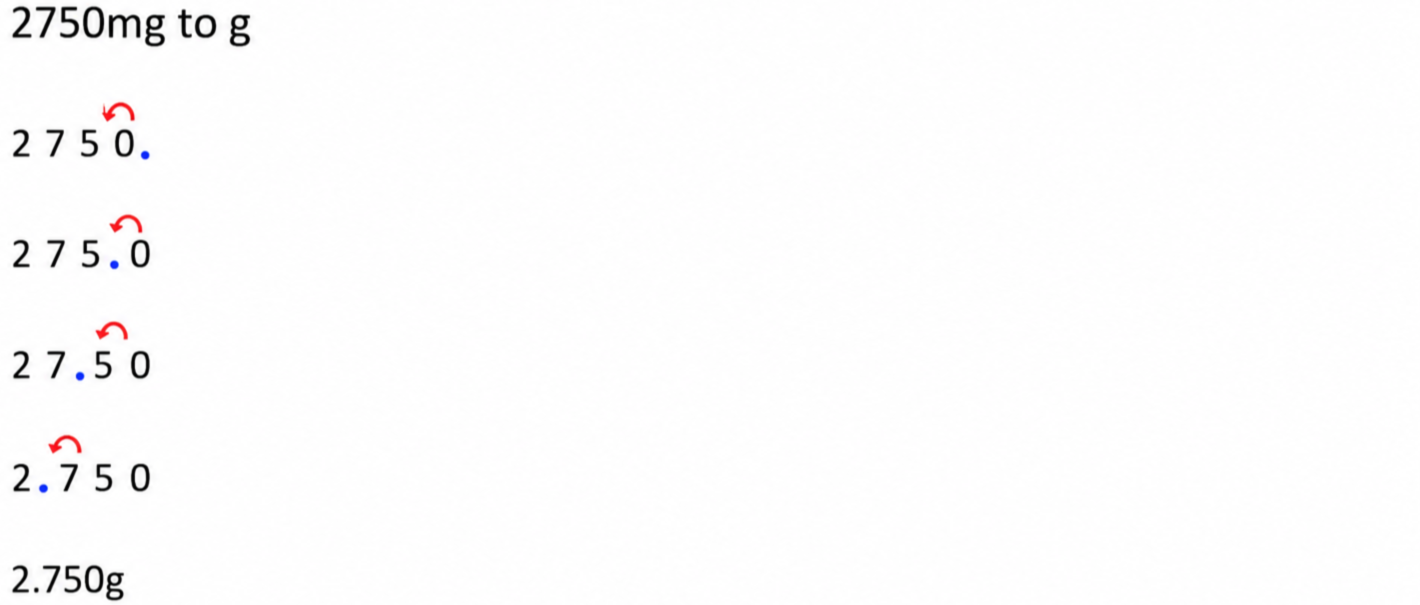
Coverting mg to g
Worked Examples
Example 1
Convert 0.5 g to mg
0.5 × 1000 = 500 mg
Check: moving from grams to milligrams (down the scale), the number should increase → correct
Example 2
Convert 250 mcg to mg
250 ÷ 1000 = 0.25 mg
Check: moving from micrograms to milligrams (up the scale), the number should decrease → correct
Example 3
Convert 1.2 mg to mcg
1.2 × 1000 = 1200 mcg
Check: moving down the scale, the number should increase → correct
Practice Questions
Convert 0.25 g to mg
Convert 750 mg to g
Convert 80 mcg to mg
Convert 2 mg to mcg
Convert 0.1 g to mcg
(scroll down for answers)
Answers
0.25 × 1000 = 250 mg
750 ÷ 1000 = 0.75 g
80 ÷ 1000 = 0.08 mg
2 × 1000 = 2000 mcg
0.1 × 1,000,000 = 100,000 mcg