The Cerebellum: Coordination, Balance & Motor Learning
The cerebellum is the brain’s centre for coordination, precision, timing, and balance. While it does not initiate movement, it plays a critical role in ensuring that all voluntary movements are smooth, accurate, and appropriately scaled. It constantly compares intended movement with actual movement and makes rapid, subconscious adjustments to correct errors in real time. This fine-tuning allows humans to walk steadily, write legibly, speak clearly, and perform complex motor tasks with fluidity. Damage to the cerebellum does not cause paralysis or weakness in the traditional sense, but instead produces profound disturbances in coordination and motor control that are highly characteristic and clinically recognisable.
What You Need to Know
The cerebellum is located at the posterior aspect of the brain, beneath the occipital lobes and behind the brainstem. It is composed of two hemispheres connected by a central structure known as the vermis. Its highly folded surface increases surface area and contains a distinctive layered cortex overlying deep cerebellar nuclei, which serve as its primary output centres.
The cerebellum communicates with the rest of the nervous system through three paired stalks called the cerebellar peduncles. Each peduncle carries a specific type of information, allowing continuous comparison between intended and actual movement:
Inferior cerebellar peduncle, conveying sensory input from the spinal cord and brainstem
Middle cerebellar peduncle, transmitting motor plans from the cerebral cortex via the pons
Superior cerebellar peduncle, carrying corrective output from the cerebellum back to motor centres
This continuous loop allows the cerebellum to compare intended movements with actual performance and adjust motor output accordingly.
Functionally, the cerebellum is divided into three major regions. The vestibulocerebellum regulates balance and eye movements. The spinocerebellum adjusts limb and trunk movements and maintains postural tone. The cerebrocerebellum coordinates complex voluntary movements and contributes to motor planning and timing.
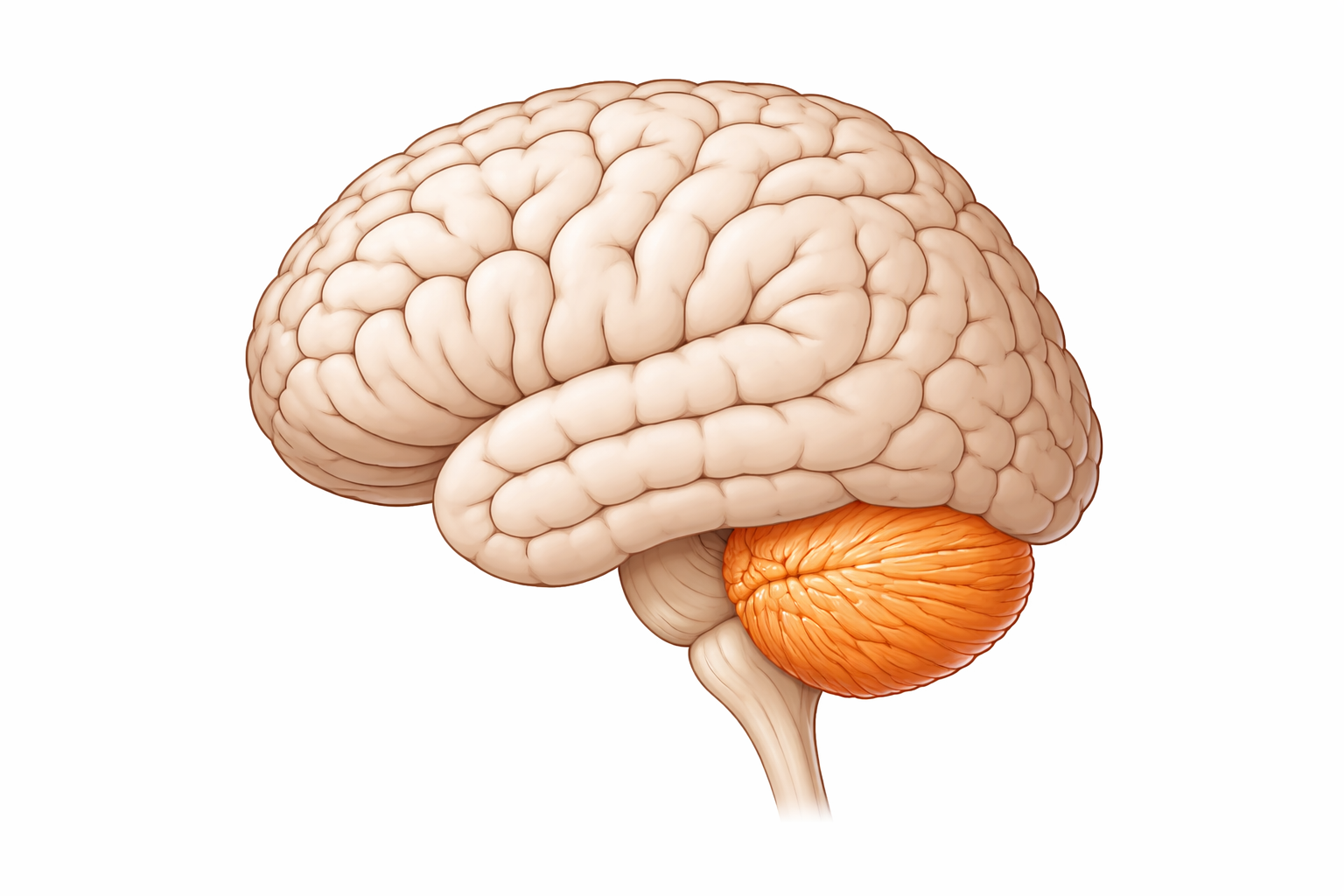
Image: Lateral view of the brain highlighting the cerebellum (in orange), located posterior to the brainstem and inferior to the occipital lobes, with its tightly folded surface reflecting its role in coordinating movement, balance, and motor timing.
Beyond the Basics
The Cerebellum as a Real-Time Error-Correction System
The cerebellum continuously monitors and adjusts movements that are already in progress. Before a voluntary action begins, a copy of the motor plan (the brain’s intended sequence of muscle activation) generated by the cerebral cortex is sent to the cerebellum. At the same time, sensory information from muscles, joints, the vestibular system (the balance organs of the inner ear), and the eyes streams back to the cerebellum, reporting what the body is actually doing.
By comparing intended movement with actual performance, the cerebellum detects even the smallest mismatches in timing, force, and direction. It then sends rapid corrective signals to the motor cortex and brainstem, refining movement as it unfolds. This entire process happens automatically and below the level of conscious awareness, which is why movements feel smooth and effortless when the cerebellum is functioning normally.
Precision, Timing, and Motor Learning
One of the cerebellum’s most important roles is in motor learning. Repeated performance of a movement strengthens synaptic connections within cerebellar circuits through cerebellar plasticity (the ability of synapses to strengthen with practice), allowing movements to become more precise and more efficient with practice. Tasks such as typing, handwriting, playing a musical instrument, or learning a sport all depend heavily on this process.
As a movement becomes well learned, the cerebellum requires less corrective input, allowing actions to be executed quickly and accurately. This form of learning is distinct from habit formation, which is primarily mediated by the basal ganglia. While the basal ganglia help decide what action to perform, the cerebellum ensures that the action is performed with optimal timing and coordination.
Coordination of Balance and Posture
The cerebellum also integrates information from the vestibular system (the balance organs of the inner ear), visual pathways, and proprioceptive receptors to maintain balance and postural stability. It adjusts muscle tone and body position continuously, allowing the head and eyes to remain stable while the body moves.
This role is especially evident when walking, turning, or standing on uneven ground, where subtle shifts in muscle activity are required to prevent falls. Without cerebellar modulation, posture becomes unstable and movements become clumsy and poorly coordinated.
Cognitive and Emotional Functions of the Cerebellum
Although long viewed purely as a motor structure, the cerebellum is now known to participate in a wide range of cognitive and emotional processes. Extensive connections link it to the prefrontal cortex, limbic system, and association areas of the cerebrum.
Through these networks, the cerebellum contributes to attention, working memory, language processing, and emotional regulation. Damage to cerebellar circuits can therefore produce not only motor incoordination, but also slowed thinking, difficulty organising tasks, and emotional changes such as irritability or blunted affect. This broader role reflects the cerebellum’s fundamental function as a pattern-detection and timing system for both movement and thought.
Ipsilateral Control and Cerebellar Pathways
Unlike the cerebral cortex, which controls the opposite side of the body, the cerebellum influences movements on the same side (ipsilateral, meaning the same side of the body). This ipsilateral control arises because cerebellar pathways cross twice through decussation (crossing from one side to the other): once when information enters the cerebellum and again when output returns to the motor cortex and brainstem. As a result, damage to one cerebellar hemisphere produces coordination deficits on the same side of the body. This principle is a key feature of neurological localisation and helps distinguish cerebellar lesions from cortical motor disorders.
Integration of Movement, Thought, and Emotion
The cerebellum acts as a master regulator of timing and precision across multiple domains. Whether refining a physical movement, smoothing the flow of speech, or modulating emotional responses, it ensures that complex systems operate with coordination and efficiency. Rather than simply making movements smoother, the cerebellum optimises how the brain interacts with the body and the world, allowing actions, thoughts, and emotions to unfold in a coherent and adaptive way.
Clinical Connections
Cerebellar dysfunction produces a distinct neurological syndrome characterised by impaired coordination rather than weakness. This syndrome is known as ataxia. Patients exhibit unsteady gait, poor balance, difficulty with fine motor tasks, and impaired limb coordination. Movements become oversized or undersized (dysmetria), and rapid alternating movements become slow and irregular (dysdiadochokinesia).
The key features of cerebellar dysfunction can be summarised as follows:
Unsteady, wide-based gait and impaired balance
Dysmetria, where movements overshoot or undershoot a target
Dysdiadochokinesia, with slow and irregular alternating movements
Intention tremor that worsens as movement approaches a target
Damage to the cerebellar hemispheres primarily affects limb coordination, producing intention tremor that worsens as the patient approaches a target. Damage to the vermis and vestibulocerebellum affects truncal stability and eye movements, resulting in wide-based gait, postural instability, and nystagmus.
Speech may become slow, slurred, and poorly coordinated, a condition known as ataxic dysarthria, reflecting impaired timing of the muscles involved in speech production. Patients may also experience vertigo and oscillopsia due to disrupted integration of vestibular input.
Cerebellar damage occurs in a wide range of conditions, including stroke, traumatic brain injury, multiple sclerosis, alcohol-related neurotoxicity, tumours, and degenerative disorders. Chronic alcohol use is a classic cause of cerebellar degeneration, particularly affecting the vermis and resulting in prominent gait ataxia.
Because cerebellar circuits influence cognition and emotion, some patients with cerebellar disease also display difficulties with attention, planning, emotional regulation, and social behaviour, a constellation sometimes referred to as the cerebellar cognitive-affective syndrome.
Concept Check
Why does cerebellar damage cause incoordination rather than true muscle weakness?
How does the cerebellum refine voluntary movement in real time?
Why are cerebellar deficits ipsilateral to the lesion?
What is the difference between intention tremor and resting tremor?
How does the cerebellum contribute to motor learning and skill acquisition?