Accountability and Responsibility in Nursing Practice
Accountability and responsibility are central to safe and professional nursing practice. Every action taken, and every action not taken, has an impact on patient care. This extends beyond recognising deterioration and includes all aspects of nursing, from routine care and communication through to documentation and decision-making. Understanding what you are responsible for, and what you are accountable for, helps guide safe, consistent, and professional practice.
What you need to know
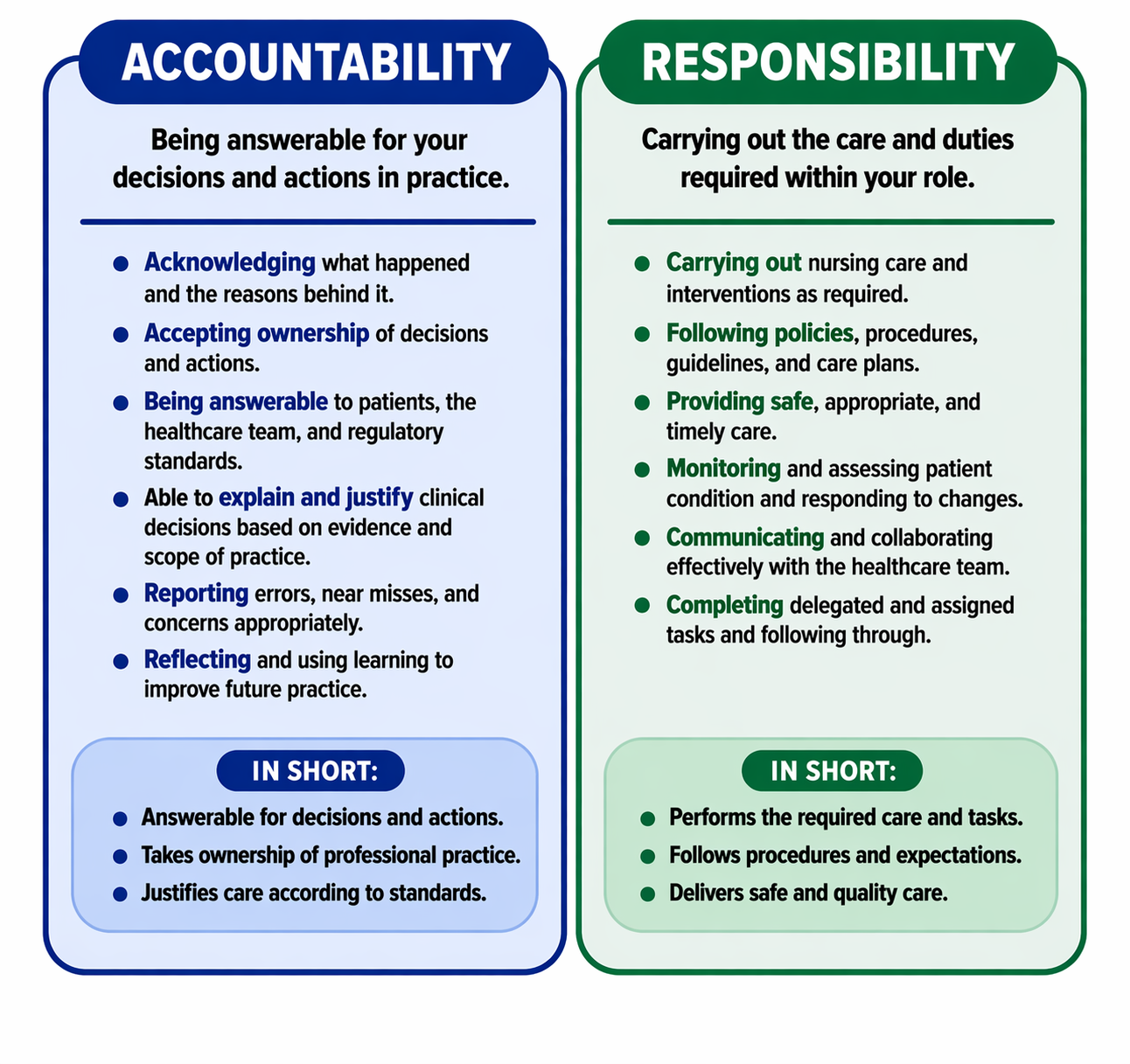
Responsibility refers to the duties and tasks that fall within your role as a nurse. This includes providing care within your scope of practice, administering medications, monitoring patients, documenting accurately, and communicating with the healthcare team.
Accountability means being answerable for the care you provide. It involves being able to justify your actions and decisions based on professional standards, evidence, and clinical reasoning. You remain accountable for what you do, what you delegate, and what you choose not to act on.
In practice, this includes:
delivering care that aligns with professional standards and policies
recognising and acting on changes in patient condition
administering medications safely and within scope of practice
documenting care accurately and in a timely manner
communicating concerns clearly to the appropriate team members
Accountability is not removed by working within a team. While care is shared, each nurse is individually accountable for their own actions and decisions.
Beyond the basics
Accountability extends into how decisions are made and how care is prioritised. Nurses are expected to use clinical judgement rather than simply completing tasks. This means understanding why care is being delivered, recognising when something is not right, and taking appropriate action.
Examples of actions nurses are accountable for include:
clarifying discrepancies in a medication order with the prescriber before administering
ensuring the correct patient, medication, dose, route, and time before administration
withholding a medication and escalating if it is clinically unsafe to give
recognising abnormal observations and initiating appropriate escalation
interpreting clinical findings and acting on them, rather than simply recording them
documenting care accurately, including what was done, observed, and escalated
following up on interventions to assess effectiveness
questioning or escalating care plans that do not align with the patient’s condition
working within scope of practice and seeking support when required
ensuring delegated tasks are appropriate and followed up
reporting errors, near misses, and incidents according to policy
These examples demonstrate that accountability is tied to clinical judgement, decision-making, and professional actions, not just task completion.
Delegation is a key area where accountability is often misunderstood. While tasks can be delegated, accountability cannot. The nurse who delegates remains responsible for ensuring the task is appropriate, that the person receiving the task is competent, and that the outcome is followed up. Failing to review delegated care or assuming it has been completed correctly can place patients at risk.
Scope of practice is another important consideration. Nurses must work within their level of education, competence, and role expectations. Taking on tasks beyond this scope, or failing to act within it, can both lead to unsafe care. Knowing when to seek guidance or escalate is part of accountable practice.
Professional behaviour also forms part of accountability. This includes maintaining patient confidentiality, practising respectfully, and adhering to legal and ethical standards. Documentation is particularly important, as it provides a record of care delivered and supports communication between healthcare providers. Inaccurate or delayed documentation can compromise patient safety and continuity of care.
Accountability also involves recognising and responding to errors. If a mistake occurs, it should be acknowledged and escalated appropriately. Attempting to conceal errors or delay reporting can lead to further harm and breaches professional standards.
In practice
In everyday nursing care, accountability is demonstrated through consistent, safe, and thoughtful practice. This includes not only completing tasks, but ensuring they are completed correctly and reviewed as needed.
For example, administering medication is not limited to giving the drug. It includes checking the prescription, confirming the correct patient, monitoring for effects, determining the appropriateness of the administratoin and documenting accurately. Each step is part of the nurse’s responsibility, and the nurse remains accountable for the outcome.
-
A nurse is preparing to administer a prescribed antihypertensive medication. On assessment, the patient’s blood pressure is significantly lower than their usual baseline. The nurse withholds the medication and escalates to the medical team for review. The prescription is subsequently adjusted to reflect the patient’s current condition.
The nurse is accountable for assessing the patient prior to administration, recognising that the medication is not appropriate at that time, and taking action to prevent potential harm rather than administering it as prescribed.
-
A nurse records a patient’s vital signs and notes a rising respiratory rate and decreasing oxygen saturation. Although the values are only mildly abnormal, the nurse is concerned about the trend and escalates to the nurse in charge. A medical review is requested, and the patient is later diagnosed with early respiratory deterioration.
The nurse is accountable for recognising the change, interpreting the trend, and acting on clinical concern rather than just documenting observations.
-
A nurse is caring for a post-operative patient and notices that the patient’s wound dressing is saturated with blood. Instead of simply reinforcing the dressing, the nurse assesses the wound, identifies ongoing bleeding, and escalates to the medical team. The patient is reviewed and returned to theatre for management of a surgical complication.
The nurse is accountable for assessing the situation, identifying that this is not expected, and escalating appropriately rather than completing the task and moving on.
Similarly, routine observations are not just recorded, they are interpreted. If a patient’s vital signs change, it is the nurse’s responsibility to recognise this and take action. Ignoring abnormal findings or failing to follow up is a lapse in accountability.
In practice, accountability involves:
completing care tasks with attention to accuracy and safety
using clinical judgement rather than working through tasks automatically
following up on care provided, including delegated tasks
recognising when to escalate concerns or seek support
documenting clearly and promptly
Accountability is part of everyday decision-making in nursing. It ensures that care is not only delivered, but delivered safely, appropriately, and in line with professional expectations.