Calculating a Drip Rate
Drip rate calculations are used when intravenous fluids are administered via gravity, rather than an electronic infusion pump. In these situations, the nurse must manually regulate the flow of fluid by adjusting the clamp on the giving set, making it essential to calculate how many drops per minute are required to deliver the prescribed volume over the correct time.
This calculation ensures that fluids are infused at the intended rate. If the drip runs too quickly, it can lead to fluid overload, while a rate that is too slow may result in inadequate fluid delivery. Accurate drip rate calculation is therefore a key step in maintaining fluid balance and ensuring safe patient care.
What You Need to Know
Drip rate calculations are used when IV fluids are administered using gravity (not an infusion pump). The aim is to determine how many drops per minute are required to deliver the prescribed volume over a set time. In this equation gtt is used, which stands for drops (from the Latin guttae, meaning drops).
In practice:
You’ll hear nurses say “drops per minute” verbally
But in calculations and written formats, gtt/min is the expected term
Key points:
drip rate is measured in drops per minute (gtt/min)
the giving set determines how many drops make up 1 mL (drop factor)
common drop factors are 10, 15, 20, or 60 gtt/mL
time must be converted into minutes before calculating
A quick check:
faster infusions → higher drops per minute
slower infusions → lower drops per minute
The Formula
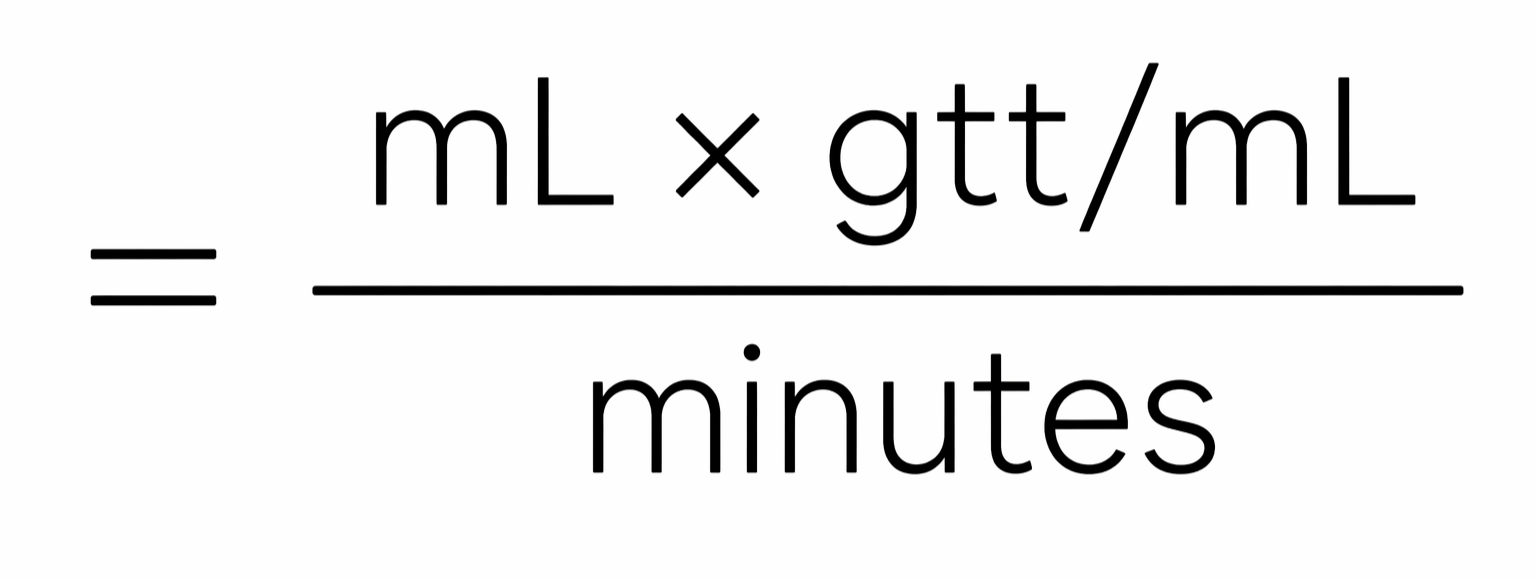
Drip rate (gtt/min) = (Volume in mL × Drop factor) ÷ Time in minutes
Where:
Volume = total fluid to be infused (mL)
Drop factor = number of drops per mL (from the giving set)
Time = total infusion time (in minutes)
Worked Examples
Example 1
Order: 1000 mL over 8 hours
Drop factor: 20 gtt/mL
Step 1: Convert time to minutes
8 hours × 60 = 480 minutes
Step 2: Apply formula
(1000 × 20) ÷ 480
= 20000 ÷ 480
= 41.6
Answer: 42 drops per minute (rounded to nearest whole number)
Example 2
Order: 500 mL over 4 hours
Drop factor: 15 gtt/mL
Convert time:
4 × 60 = 240 minutes
(500 × 15) ÷ 240
= 7500 ÷ 240
= 31.25
Answer: 31 drops per minute
Example 3
Order: 250 mL over 2 hours
Drop factor: 60 gtt/mL
Convert time:
2 × 60 = 120 minutes
(250 × 60) ÷ 120
= 15000 ÷ 120
= 125
Answer: 125 drops per minute
Practice Questions
Order: 1000 mL over 10 hours
Drop factor: 20 gtt/mLOrder: 500 mL over 5 hours
Drop factor: 15 gtt/mLOrder: 100 mL over 1 hour
Drop factor: 60 gtt/mLOrder: 750 mL over 6 hours
Drop factor: 20 gtt/mLOrder: 250 mL over 30 minutes
Drop factor: 15 gtt/mL(Scroll down for answers)
Answers
Order: 1000 mL over 10 hours, drop factor 20 gtt/mL
Time in minutes = 10 × 60 = 600
(1000 × 20) ÷ 600 = 20000 ÷ 600 = 33.3
Answer: 33 gtt/minOrder: 500 mL over 5 hours, drop factor 15 gtt/mL
Time in minutes = 5 × 60 = 300
(500 × 15) ÷ 300 = 7500 ÷ 300 = 25
Answer: 25 gtt/minOrder: 100 mL over 1 hour, drop factor 60 gtt/mL
Time in minutes = 1 × 60 = 60
(100 × 60) ÷ 60 = 6000 ÷ 60 = 100
Answer: 100 gtt/minOrder: 750 mL over 6 hours, drop factor 20 gtt/mL
Time in minutes = 6 × 60 = 360
(750 × 20) ÷ 360 = 15000 ÷ 360 = 41.7
Answer: 42 gtt/minOrder: 250 mL over 30 minutes, drop factor 15 gtt/mL
Time = 30 minutes
(250 × 15) ÷ 30 = 3750 ÷ 30 = 125
Answer: 125 gtt/min