Calculating mls per Hour for IV Infusions
Calculating mL per hour is used when intravenous fluids are administered using an infusion pump. The pump is programmed to deliver a set volume of fluid over a specific time, making it essential to calculate the correct hourly rate. This ensures fluids are delivered evenly and safely over the prescribed period.
What You Need to Know
mL per hour calculations determine how much fluid is delivered each hour. This is commonly used for IV fluids, medications, and continuous infusions delivered via an infusion pump.
Key points:
the rate is expressed as mL/hour
total volume and total time must be identified from the order
time must be in hours (not minutes)
the calculated rate is programmed into the infusion pump
A quick check:
larger volumes over shorter times → higher mL/hr
smaller volumes over longer times → lower mL/hr
The Formula
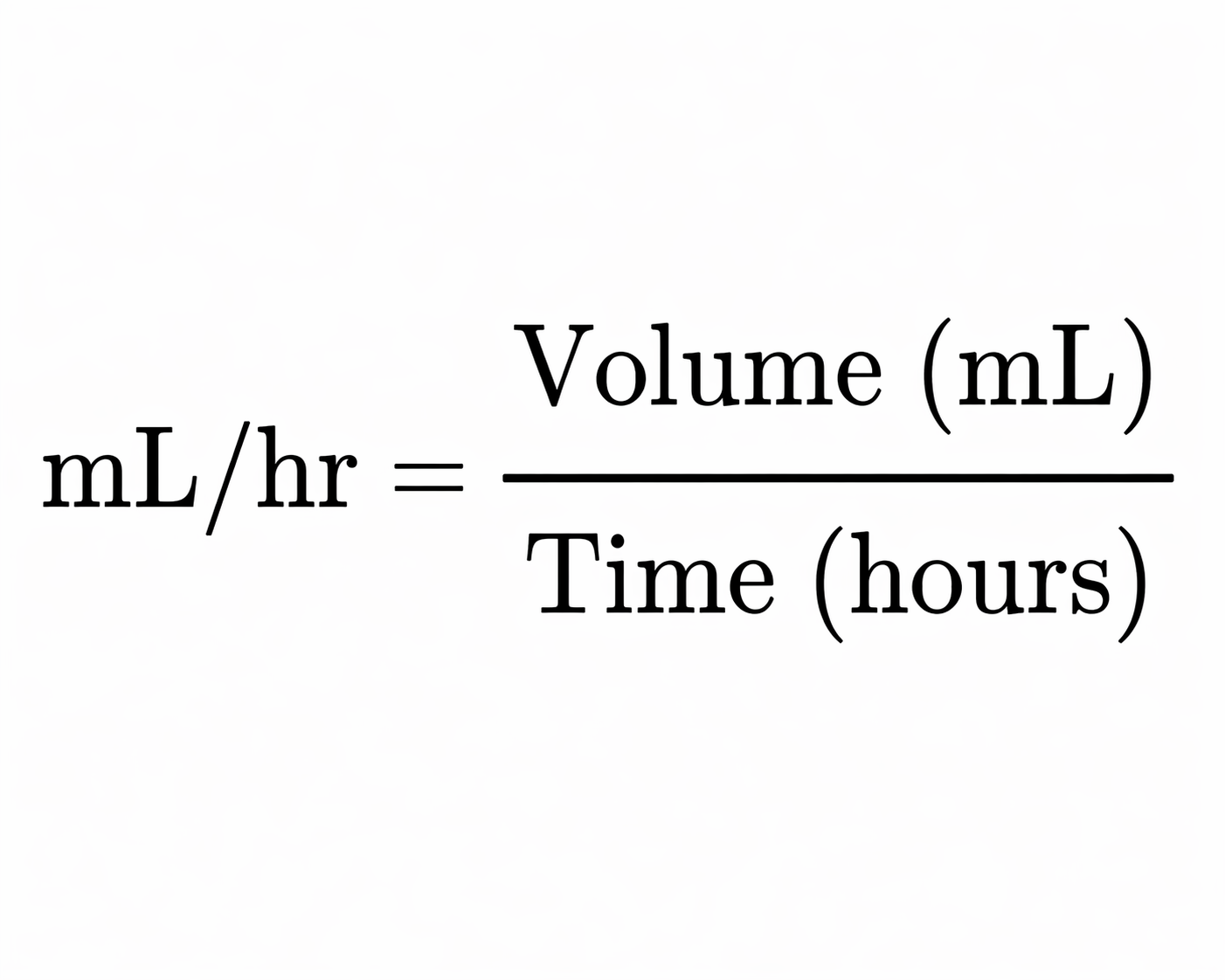
mL/hr = Volume (mL) ÷ Time (hours)
Where:
Volume = total fluid to be infused (in mL)
Time = total infusion time (in hours)
Important:
if time is given in minutes, divide by 60 to convert to hours
the final answer must always be in mL/hr
Example of converting time:
30 minutes = 0.5 hours (30 ÷ 60 = 0.5)
90 minutes = 1.5 hours (90 ÷ 60 = 1.5)
Worked Examples
Example 1
Order: 1000 mL over 8 hours
mL/hr = 1000 ÷ 8 = 125
Answer: 125 mL/hr
Example 2
Order: 500 mL over 4 hours
mL/hr = 500 ÷ 4 = 125
Answer: 125 mL/hr
Example 3
Order: 100 mL over 30 minutes
30 minutes ÷ 60 = 0.5 hours
mL/hr = 100 ÷ 0.5 = 200
Answer: 200 mL/hr
Practice Questions
Order: 1000 mL over 10 hours
Order: 750 mL over 6 hours
Order: 100 mL over 30 minutes
Order: 500 mL over 5 hours
Order: 1200 mL over 12 hours
(Scroll down for answers)
Answers
1000 ÷ 10 = 100 → 100 mL/hr
750 ÷ 6 = 125 → 125 mL/hr
100 mL over 30 minutes = 0.5 hours
100 ÷ 0.5 = 200 → 200 mL/hr500 ÷ 5 = 100 → 100 mL/hr
1200 ÷ 12 = 100 → 100 mL/hr