The Frontal Lobe: Structure and Function - Deep Dive
The frontal lobe is the brain’s command centre — the region responsible for planning, reasoning, emotional regulation, problem-solving, and the execution of voluntary movement. It is the last area of the brain to fully mature, often not reaching full development until the mid-20s, reflecting its central role in higher-order cognition and behavioural control. Because so many essential functions depend on the frontal lobe, even small areas of damage can produce striking changes in personality, decision-making, and motor ability.
What You Need to Know
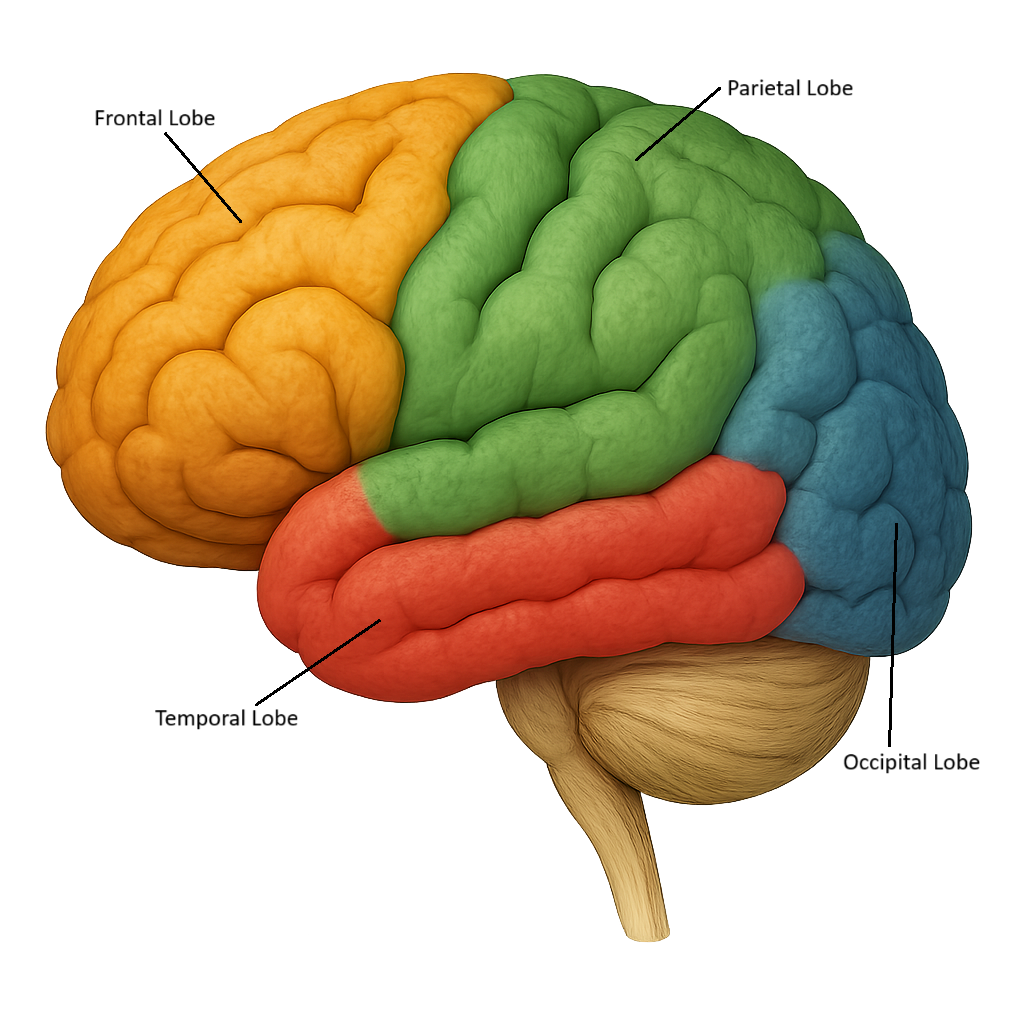
The frontal lobe extends from the anterior skull to the central sulcus and is responsible for higher-order functions that shape behaviour, movement, and communication. At its core is the prefrontal cortex, which governs executive functions such as planning, organisation, judgement, impulse control, and emotional regulation. This region integrates information from multiple systems to guide appropriate, goal-directed behaviour and plays a key role in personality. The key functional roles of the frontal lobe can be summarised as follows:
The prefrontal cortex drives decision-making, behaviour, and emotional control
The primary motor cortex initiates voluntary movement in a somatotopic pattern
Premotor and supplementary areas plan and coordinate movement before execution
Broca’s area enables the motor production of speech in the dominant hemisphere
Posterior to the prefrontal cortex lies the primary motor cortex (precentral gyrus), where voluntary movement originates. Neurons are arranged in a somatotopic pattern, meaning specific regions control specific body parts, with larger cortical areas dedicated to structures requiring fine motor control, such as the hands and face.
Adjacent premotor regions, including the premotor cortex and supplementary motor area, organise and sequence movements before they occur, ensuring actions are smooth, coordinated, and purposeful. In the dominant hemisphere, Broca’s area is responsible for speech production, coordinating the motor processes required for language output, including articulation and grammatical structure.
Beyond the Basics
The Frontal Lobe as the Centre of Executive Control
The frontal lobe is the brain’s primary centre for executive function, integrating cognition, emotion, and action into purposeful behaviour. The prefrontal cortex receives input from nearly every other region of the brain, including sensory cortices, motor areas, and the limbic system. This allows it to evaluate emotional signals, predict consequences, suppress inappropriate impulses, and select behaviour aligned with social norms and long-term goals.
This region underpins traits such as self-control, empathy, motivation, and moral judgement. When prefrontal function is disrupted, individuals may exhibit dramatic changes in personality despite preserved intelligence and memory. Disinhibition, impulsivity, emotional instability, apathy, or socially inappropriate behaviour arise not because knowledge is lost, but because the brain can no longer regulate behaviour effectively.
Functional Specialisation Within the Prefrontal Cortex
The prefrontal cortex is not a single functional unit but a network of interconnected regions with specialised roles. The dorsolateral prefrontal cortex supports working memory, attention, planning, and complex reasoning. It allows information to be held “online” while decisions are made, enabling tasks such as mental arithmetic, multitasking, and strategic thinking.
The ventromedial and orbitofrontal regions integrate emotion, reward, and social feedback into decision-making. These areas allow behaviour to be shaped by previous outcomes, guiding choices toward beneficial consequences and away from harm. Dysfunction here often leads to poor judgement, emotional dysregulation, and difficulty learning from mistakes, even when intellectual abilities are preserved. These overlapping networks demonstrate that personality and behaviour emerge from distributed frontal-lobe systems rather than a single isolated centre.
Motor Planning and Voluntary Action
The frontal lobe also contains multiple motor control regions that transform intention into movement. The primary motor cortex executes voluntary movement, while the premotor cortex and supplementary motor area are responsible for planning and coordination.
The supplementary motor area is particularly important for internally generated actions, such as initiating speech, preparing a sequence of movements, or performing a familiar motor routine without external prompting. In contrast, the premotor cortex responds to sensory cues, helping coordinate movements based on visual or auditory input, such as catching a ball or copying a gesture. These regions allow the brain to convert goals into smooth, purposeful movement.
Broca’s Area and the Motor Control of Language
Language production depends heavily on frontal-lobe motor networks, particularly Broca’s area, located in the inferior frontal gyrus of the dominant hemisphere. This region links linguistic processing with the motor patterns required to produce speech.
When Broca’s area is damaged, patients develop Broca’s aphasia, characterised by slow, effortful, and grammatically simplified speech. Comprehension is often relatively preserved, meaning individuals know what they want to say but cannot translate their thoughts into fluent verbal output. This dissociation highlights that language is not merely a cognitive process but also a motor one, requiring precise coordination of speech muscles through frontal-lobe control.
Integration of Cognition, Emotion, and Action
The frontal lobe serves as the brain’s central organising system, allowing perception, emotion, memory, and motor function to be integrated into coherent behaviour. By linking what we feel, what we know, and what we do, it enables goal-directed action, social interaction, and adaptive decision-making. Disruption of this integration explains why frontal-lobe injury can profoundly alter personality and behaviour even when other neurological functions appear intact.
Clinical Connections
Injury to the frontal lobe produces distinct and often dramatic clinical signs, many of which reflect disruption of executive function rather than loss of basic cognition. Damage to the prefrontal cortex may lead to personality changes, poor judgement, impaired insight, and difficulty planning or initiating tasks. Patients may become apathetic, impulsive, socially inappropriate, or emotionally unstable, highlighting the role of this region in behavioural regulation and goal-directed activity.
These changes often follow recognisable clinical patterns, particularly when specific functional regions are affected:
Prefrontal cortex injury: personality change, disinhibition or apathy, impaired judgement, reduced insight, and difficulty initiating or organising tasks
Primary motor cortex lesion: contralateral weakness or paralysis, with distribution corresponding to the motor homunculus
Broca’s area involvement: expressive aphasia, characterised by slow, effortful, fragmented speech with preserved comprehension
Frontal eye field damage: impaired voluntary eye movement toward the opposite side, often with gaze deviation toward the side of the lesion
Lesions affecting the primary motor cortex cause weakness or paralysis of specific body regions on the opposite side of the body. Because the motor homunculus is highly organised, the location of weakness can help localise the lesion with considerable accuracy. Damage involving Broca’s area leads to expressive aphasia, where patients understand language but struggle to produce coherent speech, often resulting in visible frustration.
Frontal lobe injuries are common in traumatic brain injury, particularly in high-velocity impacts where the brain is forced against the bony ridges of the anterior skull. Tumours, strokes, infections, and degenerative diseases may also impair frontal function. In conditions such as frontotemporal dementia, early degeneration of frontal regions produces prominent personality and behavioural changes, often preceding significant memory impairment.
Concept Check
Why does damage to the prefrontal cortex often change personality and behaviour?
How does the primary motor cortex organise voluntary movement?
Why is Broca’s aphasia characterised by non-fluent speech with preserved comprehension?
What distinguishes the roles of the premotor cortex and supplementary motor area?
Why are frontal lobe injuries common in traumatic brain injury?